Atbash Cipher Tool
Encode and decode text with the ancient Hebrew substitution cipher. Free, no sign-up, and the conversion runs in your browser.
Shortcuts: / focus input · Ctrl/⌘+Enter copy · Alt+Shift+S swap · Alt+Shift+X clear · all shortcuts
Online Atbash Cipher Tool
- Type or paste text into the input box. Letters A–Z and a–z are swapped as you type.
- Read the result in the second box. Digits, spaces and punctuation are left as they are.
- Press Copy (or Ctrl/⌘ + Enter). To decode, paste Atbash text into the same box: the swap works both ways.
Atbash Cipher Encoder and Decoder in One Box
The Atbash cipher is one of the oldest known encryption methods, found in biblical wordplay and encoded names. Now available as a modern, easy-to-use online tool.
- Real-time: instant conversion as you type, with a live count of characters, letters and words.
- One box for both directions: paste plain text to encode it, or paste Atbash text to decode it. The same mirror swap does both.
- Format kept: upper and lower case, numbers, punctuation and spaces stay where they were. Up to 10,000 characters at a time.
- Ancient: used in biblical manuscripts. The Biblical Example button loads BABEL.
- Other alphabets: this converter handles the 26-letter Latin alphabet; Hebrew, Greek, Arabic, Russian and more have their own converters.
Quick Example
HELLO→SVOOLEach letter is replaced with its mirror position in the alphabet
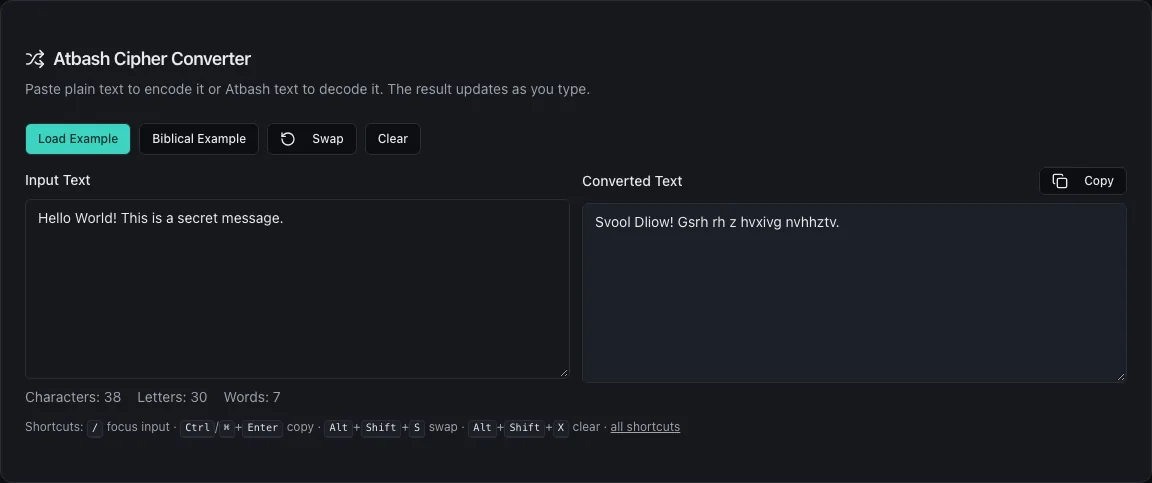
Atbash Cipher Keyboard Shortcuts
You can run the whole converter from the keyboard. On a Mac, use ⌘ for Ctrl and ⌥ for Alt.
| Keys | What it does |
|---|---|
| / | Jump to the input box. Works when you are not already typing in a field. |
| Ctrl + Enter Mac: ⌘ + Enter | Copy the converted text. Same as the Copy button; the button shows "Copied!" for two seconds. |
| Alt + Shift + S Mac: ⌥ + ⇧ + S | Swap input and result. Puts the result back in the input box, so you can check that it decodes to the original. |
| Alt + Shift + E Mac: ⌥ + ⇧ + E | Load the example sentence. Same as Load Example. |
| Alt + Shift + X Mac: ⌥ + ⇧ + X | Clear both boxes. Same as Clear. |
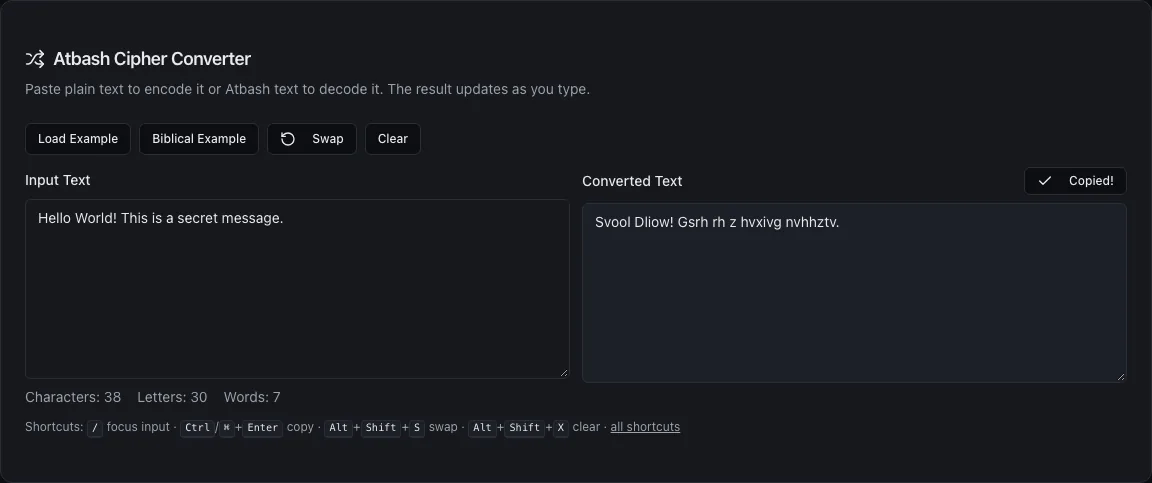
Atbash Decoder on Your Phone
On a phone the two boxes stack: input on top, result underneath, with Copy next to the result. On a 390 × 844 screen with the keyboard closed, the input box, the result and Copy all fit on the first screen, so you can paste a puzzle clue and copy the answer without scrolling. Nothing to install, and it works in any modern mobile browser.
Puzzle hunts and escape-room clues often use Atbash because it needs no key. If a clue looks like scrambled letters with normal spacing, paste it here first.
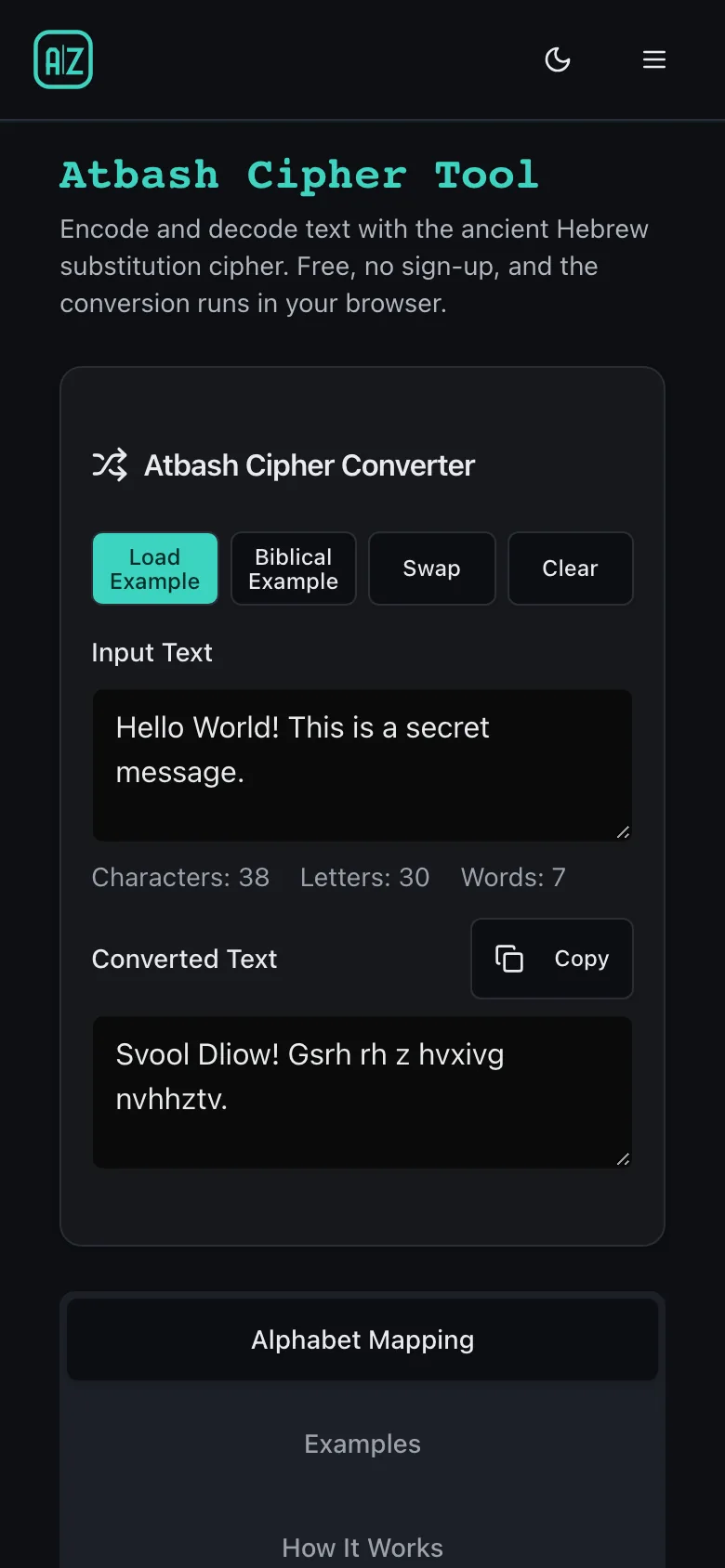
Private Atbash Decoding: Your Text Stays in the Browser
The Atbash conversion is a few lines of JavaScript that run on your device. When you type or paste, the result is computed in the page; the text is not sent to our servers and nothing is saved, so reloading the page clears both boxes. You can check this yourself: open your browser's developer tools, switch to the Network tab and type in the input box. The conversion code makes no network request containing your input.
The page itself, like most free websites, loads analytics and advertising scripts, and those see that you visited the page. Our conversion code does not pass your text to them, and the Network tab check above shows what actually leaves your browser. The privacy policy lists them.
How the Atbash Cipher Works
Master the ancient art of Hebrew encryption with our step-by-step guide
What is Atbash?
The Atbash cipher is a substitution cipher where each letter is replaced with its mirror letter from the reversed alphabet. It's like folding the alphabet in half and matching letters from opposite ends.
Why "Atbash"?
The name comes from Hebrew: Aleph-Taw-Beth-Shin. These are the first, last, second, and second-to-last letters of the Hebrew alphabet. To convert Hebrew text, including final letters, use the Hebrew Atbash cipher.
The Alphabet Mapping
Key Insight
The Atbash cipher is its own inverse! This means applying it twice returns the original text. Encoding and decoding use the exact same process.
HELLOSVOOLLetter-by-Letter Breakdown:
Biblical Example
Jeremiah 25:26 writes Babel (בבל) as Sheshach (ששך) in Hebrew Atbash. The same idea in Latin letters:
Modern Example
Secret Message
Encode These Words:
CRYPTOClick for answer
XIBKGLANCIENTClick for answer
ZMXRVMGHEBREWClick for answer
SVYIVDDecode These Messages:
HVXIVGClick for answer
SECRETXRKSVIClick for answer
CIPHERNLWVIMClick for answer
MODERNUse the converter above to check your answers in real-time!
Try the ConverterEnglish Words That Stay Words in the Atbash Cipher
On November 25, 2026 we ran every all-lowercase entry of Webster's Second International word list (the web2 file that ships with macOS and FreeBSD) through the same Atbash function this tool uses: 210,773 words. Only 32 pairs of words with four or more letters turn into each other, and the longest pair has 5 letters. With three letters there are 18 pairs. Each pair is counted once (GIRL ↔ TRIO is one pair), and the table shows 8 of the 32. In this word list, an Atbash word of four or more letters is rarely another word.
| Word | Atbash |
|---|---|
| GIRL | TRIO |
| HOLD | SLOW |
| HORN | SLIM |
| GLOW | TOLD |
| HOLY | SLOB |
| GROG | TILT |
| WILD | DROW |
| VIRAL | ERIZO |
Three-letter pairs include ALL↔ZOO, LOW↔OLD, IRK↔RIP, ART↔ZIG, ARK↔ZIP, HOB↔SLY. Some results, such as DROW and ERIZO, are rare entries that happen to be in this word list.
A different curiosity: for 14 words of four or more letters, Atbash gives the same word spelled backwards. The longest is WIZARD → DRAZIW; others are GRIT, GIRT, TRIG, VOLE, WOLD, BEVY, POLK. It happens when each letter's mirror is the letter in the mirrored position of the word (W↔D, I↔R, Z↔A).
What People Use the Atbash Cipher Tool For
GIVZHFIV → TREASURE
Atbash needs no key, so puzzle setters use it for clues. Paste the clue; readable English is a plausible decoding to check against the puzzle.
ששך (Sheshach) → בבל (Babel)
Jeremiah 25:26 writes Babel this way: in the Hebrew alphabet, shin ↔ bet and kaf ↔ lamed. The Hebrew converter shows this on the original alphabet.
HELLO WORLD → SVOOL DLIOW
Run the result through again and the original returns: a quick way to show that Atbash is its own inverse.
Atbash Cipher FAQ
Common questions about the Atbash cipher and our tool
What is the Atbash cipher?
The Atbash cipher is an ancient Hebrew substitution cipher where each letter is replaced with its corresponding letter from the reversed alphabet. For example, A becomes Z, B becomes Y, C becomes X, and so on. It is usually dated to the Hebrew Bible period, because it appears in the Book of Jeremiah, but no exact year of origin is known.
How do I use the Atbash cipher tool?
Simply type or paste your text into the input field above. The tool will automatically convert it using the Atbash cipher in real-time. You can switch between encoding plain text and decoding cipher text using the same process - the Atbash cipher is bidirectional.
Is the Atbash cipher secure?
No, the Atbash cipher is not secure by modern cryptographic standards. It's a simple substitution cipher that can be easily broken. Today, it's primarily used for educational purposes, puzzles, and understanding historical cryptography.
Where was the Atbash cipher used historically?
The Atbash cipher was used in ancient Hebrew manuscripts and biblical texts. The best-known examples are in the Book of Jeremiah: Sheshach (Jeremiah 25:26 and 51:41) is Babel written in Atbash, and Leb Kamai (Jeremiah 51:1) is Kasdim, the Chaldeans.
Is my data safe when using this tool?
Yes. The conversion runs in JavaScript inside your browser, so the text you type or paste is not uploaded to our servers. Like most websites, the page itself still loads analytics and advertising scripts; our privacy policy lists them.
Does the tool preserve punctuation and spaces?
Yes, our tool only transforms alphabetic characters (A-Z, a-z). Numbers, punctuation marks, spaces, and special characters remain unchanged in their original positions.
Does the tool change numbers or save my text?
No to both. Digits stay as they are (some puzzle variants also reverse 0–9; this tool does not), and nothing is stored: there is no notes feature or account, so reloading the page clears both boxes. Copy the result if you need to keep it.
How can I tell if a message is written in Atbash?
Look at the letter counts. In English Atbash text the most common letters E, T, A, O, I and N turn into V, G, Z, L, R and M, so a message full of V, G and Z with normal word lengths and spacing is a good candidate. Paste it into the converter: readable English coming out is a strong sign it was Atbash, though a clue may also use another cipher on top.
Is Atbash a special case of the affine cipher?
Yes. With letters numbered A = 0 to Z = 25, Atbash is the affine cipher E(x) = (25x + 25) mod 26. A (0) becomes 25 (Z) and B (1) becomes 24 (Y). Because it has no key, anyone who knows the method can read it.
Other Cipher Tools
Discover more classical ciphers and encoding tools
Start Encoding with the Atbash Cipher Converter
Type or paste text into the converter at the top of this page. The result updates as you type, and the same box decodes Atbash back to plain text.